
In the high stakes environment of 2026, many CEOs find themselves trapped. On one hand, they are being pushed to deploy Autonomous Agentic AI Workflows and lead generation engines to stay competitive. On the other hand, they are held back by massive, rigid software systems built a decade ago. These systems, often called "monoliths," were designed for a different era. They are slow to change, expensive to maintain, and completely incompatible with modern AI.
At AquSag Technologies, we call this "Technical Debt Suffocation." When your core business logic is locked inside an old system, your company cannot breathe. You cannot integrate new tools, and you cannot scale.
However, you cannot simply "turn off" the old system. It runs your payroll, your inventory, or your customer records. The solution is a strategic engineering approach known as the Strangler Fig Pattern. This guide explains how to migrate to a modern, API-First Microservices architecture without disrupting your daily operations.
What is Legacy Strangling?
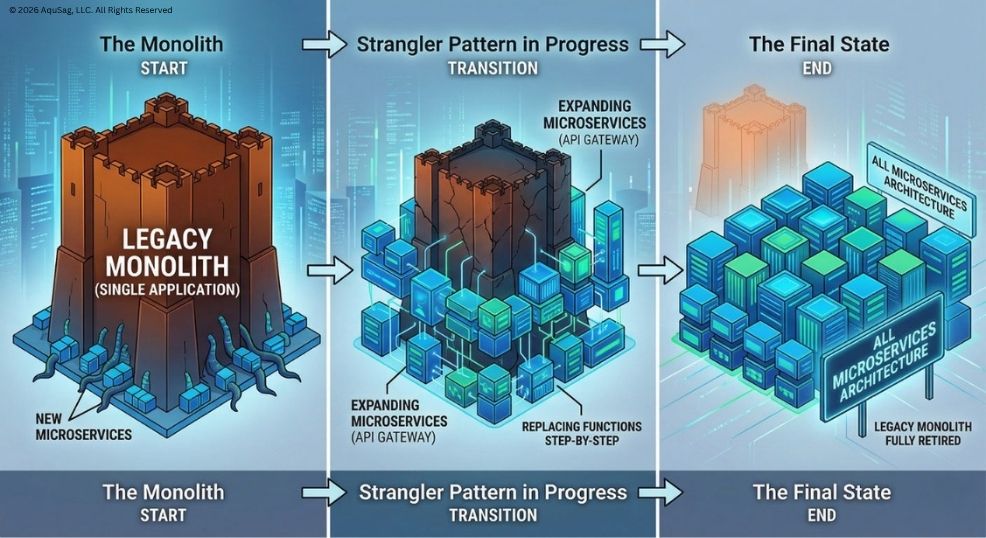
The name comes from a specific type of tree that grows around an older, existing tree. Over time, the new "strangler" tree grows so large that it replaces the original host entirely.
In software engineering, "Legacy Strangling" or Refactoring Legacy Code involves building new functionality in modern microservices that sit alongside the old monolith. Every time you need a new feature, you build it in the new system. Slowly, you move pieces of the old system into the new one until the old monolith is no longer needed.
Why "API-First" is the Secret to Success
An API-First approach means that before you write a single line of code for a new service, you design the "interface", the way it talks to other systems. This is critical in 2026 because your software no longer just talks to humans; it talks to other software, AI agents, and third party platforms.
A legacy system is not just old code; it is a weight that prevents your company from moving at the speed of the market.
The Business Case: Why Modernize Now?
For a CEO, modernization is not just a technical project; it is a financial one. If you are aiming for $1M MRR or managing a global Secure Technical Bench, you need an architecture that supports growth.
1. Enabling AI Integration
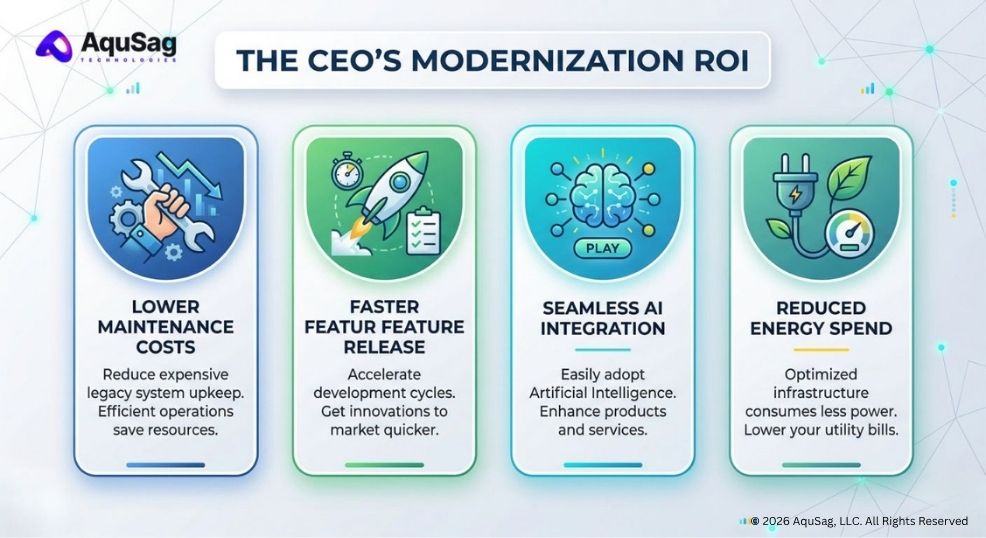
Modern AI models require clean, real-time data access. If your data is stuck in an old database with no API, your RLHF and Fine-Tuning Strategies will fail. Microservices allow you to expose specific data points that your AI needs to function effectively.
2. Speed to Market
In a monolith, a small change in the "Shipping" module might break the "Billing" module. This leads to weeks of testing for even the smallest update. In a microservices architecture, each piece is independent. You can update your The Rise of GTM Engineering engine without touching your core accounting software.
3. Cost-Efficient AI Scaling
Legacy systems are notoriously inefficient. They consume massive amounts of server power even when they aren't doing much. By moving to modern, cloud native microservices, you achieve Cost-Efficient AI Scaling. You only pay for the "compute" you actually use, which significantly lowers your monthly cloud bill.
The 4-Step Roadmap to API-First Success
At AquSag, we don't believe in "Rip and Replace." We believe in controlled, stable transitions. We deploy Managed Engineering Pods to lead this process, ensuring that your business never misses a beat.
Step 1: The API Audit
We start by mapping out every function of your current system. We identify the most "bloated" areas that are causing the most delays. We then design an API "Gateway" that acts as a bridge between the old world and the new world.
Step 2: Extracting "High Value" Services
We don't move everything at once. We start with the services that will drive the most revenue. For many clients, this is the sales funnel. By building a modern API for your customer data, we can immediately plug in Signal-Based Selling Automation tools to start generating new business while the rest of the migration continues.
Step 3: Implementing a Data Mesh
As we break apart the monolith, we ensure that data doesn't become siloed again. We implement a Data Mesh Architecture where each microservice "owns" its data but shares it through standardized APIs. This makes your entire organization more transparent and data driven.
Step 4: Continuous Governance and Security
Old systems are often full of security holes. As we build the new architecture, we integrate AI Red-Teaming and Governance from day one. Every new API is stress tested and hardened against modern adversarial attacks.
The Role of Stability in Digital Transformation
Transformation is scary. The biggest risk is that the "new" system is less stable than the "old" one. This is why we provide Stability as a Service.
When we refactor your code, we don't just hand over a new system and leave. Our managed pods stay on as your Technical Infrastructure Partner. We provide the "technical bench" that monitors the new microservices, ensuring 99.9 percent uptime and immediate response to any issues.
Why Managed Engineering Pods are Replacing Staff Augmentation
Sustainability: The Hidden Benefit of Microservices
Legacy systems are "energy hogs." They were written in an era where server power was cheap and environmental impact wasn't a concern. Modernizing your stack is a core part of achieving your ESG goals.
Through our Green IT Audits and Carbon-Aware Computing services, we measure the energy savings of your new architecture. Microservices can "sleep" when they aren't in use, which drastically reduces your carbon footprint and your electricity costs.
Modern code is green code. Efficiency in logic leads to efficiency in energy.
Why AquSag Technologies is Your Partner for Modernization
We aren't just a staffing agency; we are an Engineering Infrastructure and Solutions Leader. We have successfully managed complex data migrations for firms like Tata and supported engineering delivery for global system integrators like NTT Data.
We understand that for a CEO, the "how" is less important than the "result." You need a system that is fast, secure, and ready for the AI revolution. We provide the "managed intelligence" to get you there.
Our Legacy Modernization Services Include:
- Full "Strangler Fig" Migration Planning.
- API-First Architecture Design and Implementation.
- Refactoring Legacy Code into high performance microservices.
- Managed "Migration Pods" to ensure zero business downtime.
- Integration of Cost-Efficient AI Scaling protocols.
- Green IT Audits to measure transformation ROI.
Stop Being Held Hostage by Your Own Code
The software you bought or built ten years ago should not be the reason you fail today. If your engineering team is telling you that "it is impossible to integrate AI" or "the system is too fragile to change," you have a legacy problem.
It is time to strangle the monolith. Let us help you build a modern, API-first foundation that empowers your team and excites your customers.
Contact AquSag Technologies to Modernize Your Infrastructure
Are you ready to break free from technical debt and build a secure technical bench for the future? Our team is ready to guide you through a low risk, high reward migration to microservices.
Contact AquSag Technologies and Refactor Your Legacy Systems Today