
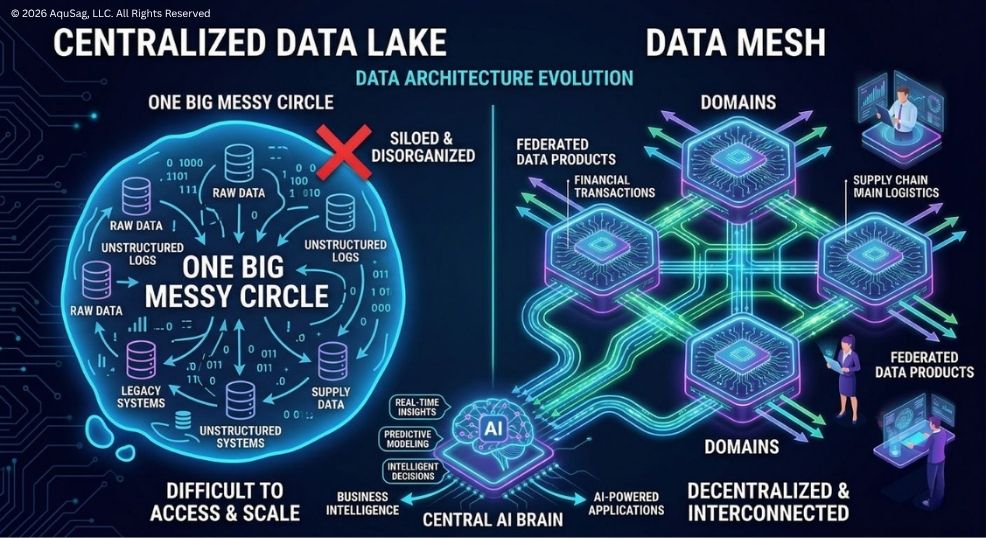
In the previous decade, the dream of every CIO was the "Data Lake." The idea was simple: pour every scrap of company data into a single, massive reservoir and let the data scientists figure it out. But as we move through 2026, that dream has largely become a nightmare of "Data Swamps," where information goes to die, hidden under layers of broken pipelines and missing metadata.
At AquSag Technologies, we have seen global enterprises struggle with this central bottleneck. When your data is centralized, your innovation is throttled. The central data team becomes a "wait-list" rather than an accelerator. To solve this, the industry's most advanced players are moving toward a Data Mesh.
A Data Mesh is not just a new tool; it is a fundamental shift in how we think about the ownership of information. It moves from "centralized control" to "distributed empowerment." This roadmap will guide you through the technical and cultural requirements to make this shift a reality for your organization.
What is a Data Mesh and Why Does it Matter Now?
The Data Mesh is a decentralized architectural pattern that treats data as a product, owned by the people who know it best: the business domains.
In a traditional setup, the sales team knows the sales data, but they hand it off to a central IT team to manage. This "handoff" is where context is lost. In a Data Mesh, the sales team (or the engineering pod supporting them) is responsible for providing their data in a clean, usable format to the rest of the company.
The Four Pillars of Data Mesh:
- Domain-Oriented Ownership: Data is owned by the specific business unit (Sales, Marketing, Engineering) that creates it.
- Data as a Product: Data must be discoverable, addressable, trustworthy, and self-describing.
- Self-Serve Data Platform: A central infrastructure that allows domains to create and consume data "products" without needing a central team to build the plumbing.
- Federated Computational Governance: A set of global rules (security, compliance, quality) that are automatically applied across all domains.
The Data Mesh is the only architecture that scales at the speed of modern AI. If your data is a bottleneck, your AI will be a hallucination.
Why Data Mesh is the Foundation for 2026 AI
We cannot talk about data in 2026 without talking about Artificial Intelligence. Whether you are building Autonomous Agentic AI Workflows or fine-tuning models via RLHF and Fine-Tuning Strategies, the quality of your output is entirely dependent on the accessibility of your data.
1. Fueling Agentic Workflows
An autonomous agent is only as smart as the data it can access. In a centralized model, an agent might have to wait for a database query to clear a central firewall. In a Data Mesh, the agent can directly "query" the Sales Data Product or the Supply Chain Data Product, allowing for real-time decision-making.
2. Specialized Model Training
To build a truly domain-specific LLM, you need high-quality, high-context data. Because the Data Mesh ensures that the "Domain Experts" are the ones cleaning the data, the training sets used for your LLM Fine-Tuning are significantly more accurate than those pulled from a generic data lake.
3. Real-Time Signal Detection
If you are running a Signal-Based Selling Automation engine, you need signals from across the company. A Data Mesh allows your GTM engine to "subscribe" to a live stream of product usage data, triggered directly from the engineering domain.
The Technical Roadmap: How to Build Your Mesh
Implementing a Data Mesh is a multi-phase engineering challenge. At AquSag, we approach this through a structured deployment of Managed Engineering Pods who specialize in decentralized architecture.
Phase 1: Define Your Domains
You cannot boil the ocean. Start by identifying three core domains that would benefit most from data autonomy. Often, this is Sales, Product, and Finance. We help you define the "boundaries" of these domains so that there is no overlap in ownership.
Phase 2: Build the Self-Serve Platform
This is the "Infrastructure" part of the mesh. You need a platform that handles the boring stuff, storage, compute, and identity management, so the domains can focus on the data. We often find that Refactoring Legacy Code to API-First Microservices is a necessary first step here to ensure that old systems can "talk" to the new mesh.
Phase 3: Implement Federated Governance
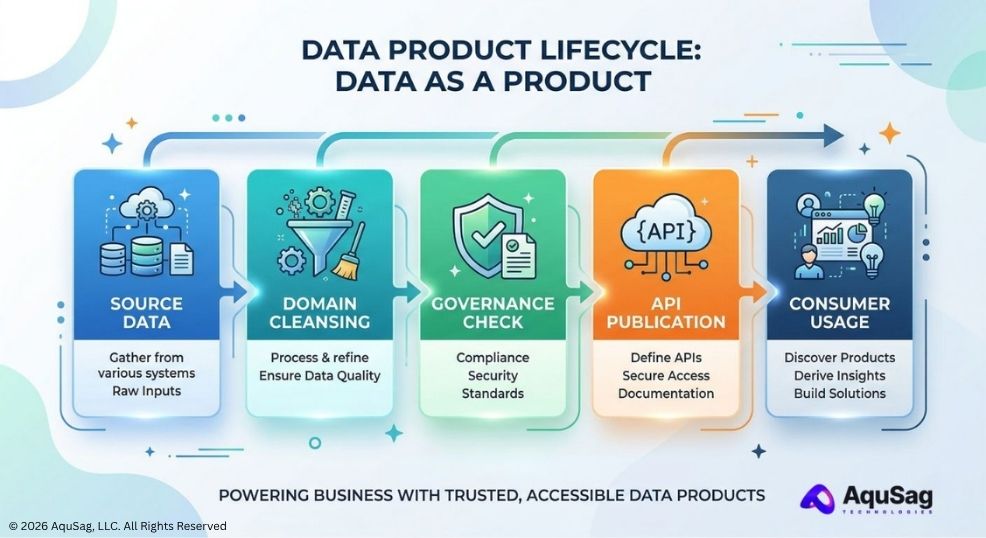
How do you ensure that decentralized data is still secure? You automate the rules. We bake security protocols directly into the data pipelines. This ensures that every data product is compliant with your AI Red-Teaming and Governance standards from the moment it is created.
Phase 4: Data Product Delivery
Each domain begins publishing its data as a "product." This means the data has an API, a clear set of metadata, and a "quality score." This is where your company starts to feel the shift in velocity.
The Role of Stability in a Decentralized World
A common fear with Data Mesh is that "decentralized" means "chaotic." This is why we provide Stability as a Service.
When you distribute ownership, you need a Secure Technical Bench that stays consistent. If the "owner" of the Sales Data Product leaves the company, the product cannot simply break. Our managed pods ensure that the "institutional memory" of each domain is preserved, providing the consistency needed to keep the mesh alive.
Why Managed Engineering Pods are Replacing Staff Augmentation
Optimizing for ROI and Sustainability
Data Mesh is not just an architectural choice; it is a financial and environmental one.
1. Cost-Efficient AI Scaling
By allowing AI models to access only the specific data products they need, you reduce unnecessary data transfer and compute costs. This is a core part of our Cost-Efficient AI Scaling methodology. You aren't paying to "search" a massive lake; you are paying to "access" a specific product.
2. Green Data Engineering
Centralized data lakes often store "dark data", vast amounts of information that is never used but still consumes server power. A Data Mesh encourages domains to only "productize" what is actually valuable. This fits perfectly into our Green IT Audits and Carbon-Aware Computing services, as it naturally reduces digital waste.
Challenges to Anticipate
The road to a Data Mesh is not without its bumps. It requires a massive change in mindset.
- The Cultural Shift: Teams are used to "hoarding" data or letting "IT" handle it. Moving to a product mindset takes time and leadership.
- The Complexity of 2026 Tech: Managing a mesh across multi-cloud environments (AWS, Azure, GCP) requires a partner who understands the deep plumbing of the cloud.
- Legacy Debt: Older systems are often resistant to being "meshed." This is why we focus heavily on Refactoring Legacy Code as part of our initial audit.
Why AquSag Technologies is Your Data Mesh Partner
We are more than a staffing firm; we are a Technical Infrastructure and Engineering Partner. We have the specialized experience of building decentralized systems for global giants and system integrators.
We provide the "managed intelligence" required to bridge the gap between your current data silos and a future-ready mesh. Our teams don't just write code; they design the foundational structures that allow your company to scale to $1M MRR and beyond.
Our Data Mesh Services Include:
- Domain Discovery and Architectural Design.
- Self-Serve Data Platform Engineering.
- Automated Governance and AI Red-Teaming Integration.
- Legacy System Refactoring for Mesh Compatibility.
- Managed "Data Pods" for continuous domain support.
Stop Drowning in Your Data. Start Meshing.
The era of the "Central Data Bottleneck" is over. If you want your organization to move at the speed of 2026, you need a data architecture that is as decentralized and agile as your business.
Empower your domains and fuel your AI. Let us help you build a technical roadmap that turns your data into your most valuable product.
Contact AquSag Technologies to Implement Your Data Mesh
Are you ready to decentralize your intelligence and build a secure, stable technical bench for your data future? Our team is ready to help you navigate the complexity of Data Mesh implementation with total confidence.
Hire AquSag Technologies and Scale Your Data Infrastructure Today